Categories
4 out of 5 Adventure Interactive Fiction

Mission Impossible

Publisher: Adventure International

Designer: Scott Adams

Type: Adventure

Platform: Various

Release Date: 1979

Rating: undefined

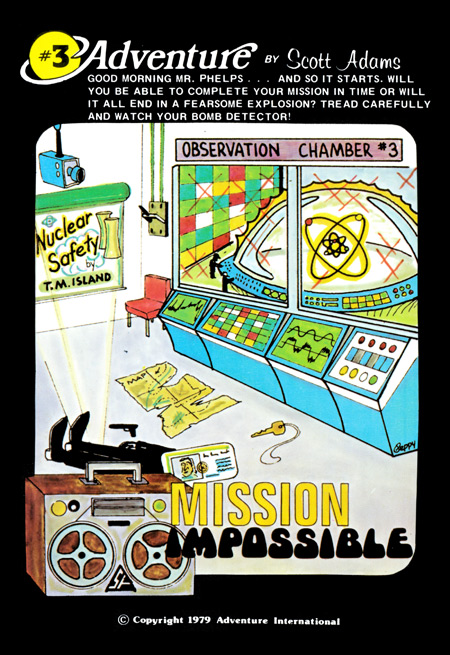
This is the third of Scott Adam’s adventures, and it is one that was based on the popular television show at the time, Mission Impossible. Sure, many of us probably associate this series with the more recent Tom Cruise movies (which I believe has spawned something like 6 so far) but back in the day it was actually a television show. You play Jim Phelps (Ethan Hawke was an addition for the movies since the movies were supposed to follow on from the series) and you find yourself in a nuclear power plant. Your job, if you chose to accept it (not that you have any choice because, well, you can’t leave the power plant) is to stop it from going into meltdown.

Well, this is the first of the games where you don’t have to collect treasures. Instead, you have to make your way around the plant and work out how to stop it from, well, blowing up. Okay, you don’t quite have a time limit, though I suspect adding such a limit wouldn’t have been all that hard. However, we must remember that this was one of the earlier games, so the developer (namely Scott Adams) was no doubt experimenting with the style. I guess the fact that he has moved on from simply having one travel around a land, solving problems, and collecting treasure, certainly does add a lot to this game.

It was one of the earlier games that I played, namely because the computer that we had was, well, somewhat limited in the software that was available. However, my Dad did end up collecting a lot of these games, namely because I liked them so much. It is hard, don’t get me wrong, and once you complete it, it really doesn’t have all that much replay value either. Sure, I might have not played it for ages, but I do suspect that if I were to fire it up again, then, well, I could probably complete it pretty quickly (and even then, the solution is online as well).

Anyway, this game is also known as Secret Mission, no doubt because the owners of the show weren’t too happy that Adams was stealing and using their property (no doubt to attract more customers). Mind you, these days companies go out of their way to merchandise products through software, but this was back in 1979.

There doesn’t appear to be a Wikipedia entry for this game, though there are solutions, including one for the TRS-80 (which also includes details on that version of the game), as well as a walkthrough in Ultimate Game Solutions.

Categories
3 out of 5 RPG

Ultima I: The First Age of Darkness

Publisher: Origin Systems

Designer: Richard Garriot

Type: Roleplaying

Platform: Various

Release Date: 1981

Rating:

As you can probably discern from the title, this was the very first of the Ultimas, a game that ended up not only spawning eight sequels, several offshoots, and one of the first MMORPGs. So, this one takes up right back to the beginning where we can experience what it was like to actually play a computer roleplaying game back in the early eighties, and it certainly does have quite a lot of charm about it, even if it might not be on the scale of Skyrim.

Well, considering that it was originally released on an 8-bit machine, we certainly can’t expect Skyrim, but then again, for its time, it certainly did break a lot of boundaries. In fact, you had a quest, which differs from a lot of the other games at the time, which just involved you descending into dungeons and killing as many monsters as possible until you died. No, this one you had to go on a quest to kill a powerful mage.

The game involved you travelling over multiple continents, visiting multiple towns, and descending into multiple dungeons, mostly to build up your power so that you could then go and deal with that really nasty mage that you are supposed to kill. It was fun when I played it, and it certainly did steal hours of my life back when I was a teenager.

I guess, as I mentioned, it is certainly not something that you could hold up to modern games, but it is great to see what it was like back in the day. Oh, and the game was initially a top-down view, but that changed when you entered the dungeons. This was a format that the game used for most of its sequels, at least until Ultima 6 (as far as I’m aware).

Anyway, not surprisingly, this game appears on Wikipedia (something a a number of other games haven’t managed to do, which probably says a lot about that particular game). Also, I have discovered two wikias from Ultima – the Codex of Editable Wisdom, and the Ultima Codex. Of course, there are plenty of walkthroughs as well, of which this is one.

Categories
2 out of 5 C64 Shoot-em Up

F1 Tornado

Publisher: Zepplin Games

Designer: Wahid Kahn, Neil Hislop

Type: Shoot-em Up

Platform: C64

Release Date: 1991

Rating:

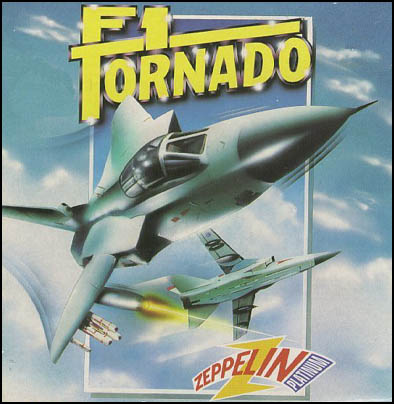
I wasn’t really sure what to expect when I came to this game, that is whether it was a shootem-up or not. Well, it turned out that it isn’t a flight simulator, but rather a shootem-up, and a pretty hard one at that. You are basically flying a jet fighter and you have lots of enemies coming at you, as well as lots of ships firing stuff at you, and well, yeah, that is about it.

Actually, I found that the baddies pretty much come at you really thick and fast, which made it really, really hard to avoid getting blown up, when it was being hit by a missile (or rather a bullet) from one of the ships or being struck by one of the many planes that seem to come flying in your direction. The thing was that you really don’t seem to be given all that much breathing space, which meant that even if I managed to shoot down, or avoid, one of the many swarms that were coming towards me, then another lot would come. As it turned out, I spent more time dodging things than actually shooting any of the baddies down.

Then there are the ships. Well, there was just way, way too many of them. In fact, it felt as if I was flying over an entire fleet, and of course, you do have to avoid them because, well, planes and ships tend not to mix, especially if you slam into them at the speed that you are travelling. I did work out that you can actually shoot down the turrets, but of course you do have to pull up before, well, splatting against the bridge.

Yeah, this game was just way too hard for my liking, and I’m glad I never forked out any money for it when I was a kid, though I do suspect that maybe, just maybe, it was one of those el-cheapo games, which still doesn’t mean that it was value for money.

Well, not surprisingly, there is no Wikipedia page, but you can find some details (as scant as they are) on Lemon 64.

Categories
2 out of 5 Atari Maze Miscellaneous Arcade

Pacman

Publisher: Atari Inc

Designer: Atari Inc

Type: Maze

Platform: Atari 2600

Release Date: 1982

Rating:

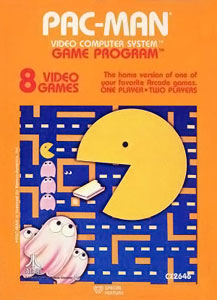
I probably shouldn’t be too harsh on the Atari 2600 considering that it not only is an 8-bit machine, but it was also really really popular. The most common joysticks that I found when I was a kid happened to be the Atari joysticks, not that they were good mind you. In fact, they were pretty bad, and quite prone to breaking. However, let us consider this game, which ironically was the most popular game on the machine.

However, imagine driving a car when your breaks don’t work (not that I would encourage you to test it out because you are likely to cause more damage than to). Well, that is what it was like playing this game.

Honestly, I found that once I sent Pacman in a direction it was really, really hard turning corners because, well, he would just go, and go, and then run into a ghost.

Yeah, controlling this game was an absolute nightmare. Sure, maybe it was designed that way to make the game a little harder, not that I can recall playing it on any other machines, at least in the not too distant past. However, I did attempt to play this game, and it was a nightmare, even if it was simply because I couldn’t make sharp turns, stop, or avoid the ghosts.

Anyway, you can find more about this version of Pacman on Wikipedia, and there is also an entry on Pacman’s very own wiki page. Actually, as a point of note, if you type Pacman into Google, you will find a playable Pacman Google doodle.

Categories
4 out of 5 Adventure Interactive Fiction

Pirate Island

Publisher: Creative Computing Software/Adventure International

Designer: Scott Adams

Type: Adventure

Platform: Various

Release Date: 1979

Rating:

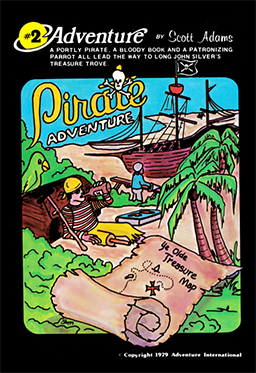
This is the second of Scott Adams’ adventures, and it is slightly different to the first one in that this time you aren’t just exploring a maze collecting treasure, and bringing them back to a single place. No, instead you have to go on a quest to actually find a pirate’s treasure horde and bring it back home. So, much of the game involves not just getting to the island but also building your own ship so that you can actually sail to this island.

I believe that this game is actually based on the story of Treasure Island, though I don’t actually believe you play any of the major characters, and you certainly don’t meet Peter in the game. Actually, the characters that you do meet don’t really have names either (that is if you actually meet any characters – it has been a while since I have played it, but I certainly have played it quite a lot). I actually found the game to be quite challenging in a way, but since it was pretty much one of the first games I ever got it was also one of the first games that I completed.

As I mentioned, the game itself is challenging, though I don’t believe that it is really all that hard. The problem is, of course, that once you manage to complete it you sort of know how to get to the end of the game, so replayability is really not something that is a factor. However, I do remember that this game was pretty much available for most of the platforms that I encountered. In fact, a friend even had a cartridge that you would plug into the back of his Vic-20.

Once again though, I decided to actually play through this game because, well, it isn’t that long. Yeah, it’s pretty fun, especially since you get to build a ship, though inventory is a bit of a problem because there is only so much you can carry (though, of course, that goes without saying, doesn’t it). The problems are pretty tricky, and it took me a while to work out what I need to hold to book to intone the magic word. However, you don’t need an intricate knowledge of treasure island to be able to finish it. It’s tricky, but fun.

Oh, and the graphical version is certainly better than the first game because the game shows the graphics and the text at the same time, and even shows the objects that have been dropped in the specific locations. However, the problem that does arise is that the location details pretty quickly disappear being the picture, which will result in you have to look multiple times. Still, at least you can play the game with the piccies without constantly swapping around.

Anyway, Wikipedia probably provides a much more objective view of the game, though I also discovered that the source code is also available (and on the internet as well). Oh, and if you want a walkthrough, there are a few on the internet, though I did find this one fairly quickly.

Categories
5 out of 5 Adventure RPG

The Bard’s Tale

Publisher: Electronic Arts/Interplay Productions

Designer: Micheal Cranford

Type: Roleplaying Game

Platform: Various

Release Date: 1985

Rating:

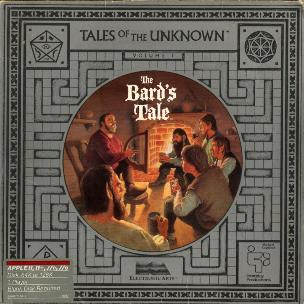
I still remember when this game first appeared – it was literally a revolution in the style of the Computer Roleplaying Game. Sure, it is pretty basic, but that is what is to be expected for a game that appeared in the 80s. Also, it isn’t as big as some of the other games, fitting on just a single C64 disk, with one side being for the city, and the boot, and the other side being for the dungeons. From what I remember there are only four (or five) dungeons to explore, so yeah, the game isn’t actually that big, though of course, these dungeons are of a decent size.

I’m not quite sure of the story, but you start in the city of Skara Brae (which is named after a small prehistoric city that is located on an island in Scotland – if it wasn’t for Bards Tale, this rather small town, consisting of only 8 houses, would have gone by the wayside), which has been taken over by some evil mage named Mangar. So, your quest is to basically kill Mangar – something that I managed to accomplish back in my teenage years.

Honestly, I wouldn’t recommend playing this game on a C64 emulator because, honestly, it is really, really, really slow, and there is no what to speed up the combat either, and the combat can get pretty long. Sure, there are somewhat faster PC versions, and the graphics are slightly better as well. However, if you really want to play this game they have recently released an enhanced version, which is available on Steam. Yeah, this is something that I am really tempted to check out sometime, though not right away.

While it certainly doesn’t come close to any of the games that I have played recently, this game still has a charm and a legacy, about it that will keep it in the annals of classic computer games.

Anyway, you can find out more about this game on Wikipedia, or you can even check out a wiki page dedicated to it, and the service. Oh, and if you want some hints then a page has been set up for that as well.

Categories
3 out of 5 Arcade Adventure Nes

The Legend of Zelda

Publisher: Nintendo

Designer: Takashi Tezuka

Type: Arcade Adventure

Platform: NES

Release Date: 1986

Rating:

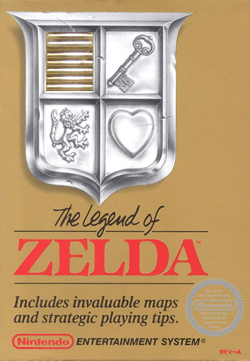
I’m not quite sure whether I could go as far as suggesting that this game is a proper roleplaying game, though I should point out that you do have quests, and you can not only pick up things, but you can also increase your character’s power through collecting, and buying, items. The other thing about this game is that fortunately when you die (you really don’t have that much in the way of health) is that while you go back to the start, you retain all of the stuff that you had when you were killed, which certainly does make this game a little easier.

Still, in many ways, this game does feel like it is just another arcade-style game, but I shouldn’t be too harsh on it because we are dealing with one of the original Nintendo consoles, which means that you only had two buttons on your controller. Also, the nasties that you have to battle aren’t all that fancy, but once again, I should point out that we are dealing with a rather old retro-game here.

It is fun though, despite it being pretty basic, and it certainly does look as if it is a pretty big game, which means that it is going to give you hours upon hours of gameplay. However, the instructions do point out that the nasties do get harder the further into the game you get, which sort of worried me because I found that the nasties around the start were pretty bad nonetheless. Yet, despite that, I did find out once you play it for a while you do eventually get the hang of the engine, which does make dealing with them somewhat easier.

Yeah, this game isn’t too bad, and of course, when we look at the later consoles that came about, there is certainly something to look forward too.

Anyway, you can find more information of this game (as well as the series as a whole) on Wikipedia, though I should mention that this game has a whole wikipage to itself as well, which you can also enjoy.

Categories
4 out of 5 Adventure Interactive Fiction

Adventureland

Publisher: Creative Computing Software

Designer: Scott Adams

Type: Adventure/Interactive Fiction

Platform: C64

Release Date: 1978

Rating: undefined

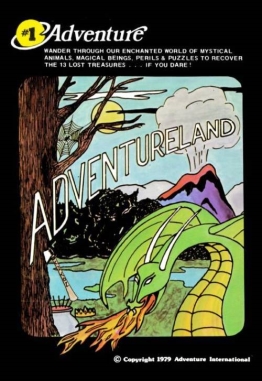
While this isn’t the first-ever adventure game (or should I call it an ‘Interactive Fiction’ which is what they seem to be called today) it certainly is up there with the originals. I should point out first of all that this is entirely text-based, though later iterations of this game did have graphics added to it, that doesn’t mean that you can simply sit down with your controller and play it as if you were playing Super Mario Bros.

No, this is a game where you enter commands into the parser, effectively telling the computer what you want to do. The parser is two words, namely action and verb, though sometimes it might as for some clarifications. A description of the room is given to you at the top of the screen, as well as any items that you might see there, which does give you a bit of a hint as to what can be done there.

It’s not really that hard, but then again I did complete it when I was something like nine years old, and it has been around for so long that you can easily find a solution of the internet. However, that doesn’t mean that you should actually use the solution because it sort of destroys the fun of trying to work out what to do, and to solve all the puzzles.

The concept is pretty simple though, you have to find all of the treasures, bring them back to one particular spot, and then type on Score. Once you have all the treasures there, then you basically win the game. Mind you, I generally bring each and every item back to this one spot as well, namely because it helps me know where things are. However, you don’t really need to do that as the treasures are pretty obvious when you come across them.

Well, I decided that I would replay it (after initially writing this review) namely because it is a rather short game, and I hadn’t played it for a while. One of the things that I noticed is that if you die, you go to limbo, where you can escape if you head in the right direction. Mind you, there are a few ways of dying, such as wandering into the meadow with some evil-smelling mud, which results in the dragon waking up and killing you. However, despite the fact that you can sort of escape death, that doesn’t mean you can’t get snookered, as there are things that you can do that will make the game impossible to complete.

Oh, and for the problems, well, they are generally okay, but there are a couple, such as the one involving Paul Bunyan, that sort of end up having you guess how to deal with it. Okay, knowing the story probably won’t help all that much, but while most of the problems can be solved (or have hints as to solving them), some of them require a bit of joining a couple of rather distant dots together. Also, considering problems, there is a graphical version on the C64 (the version I played), and you can tell that it is the first because you need to switch between the pictures, and the text, which is quite annoying mind you.

As I said, it isn’t really that easy, but the problems are solvable. The catch with this game is that you don’t necessarily know all of the commands that you can use, and this it sometimes takes some guesswork. However, for the first in a series, it still is pretty good, and it certainly does have a lot of historical value as well.

Anyway, you can find out more about this game on Wikipedia, and of course, if you want to play it, along with the many emulators and versions that exist, you can also play it online.

Categories
2 out of 5 Beatem Up C64

Express Raider

Publisher: Data East

Designer: Zoltán Kanizsai, Zoltan Czigler, Istvan Ratkai, Ferenc Frank

Type: Beat-em Up

Platform: C64

Release Date: 1986

Rating:

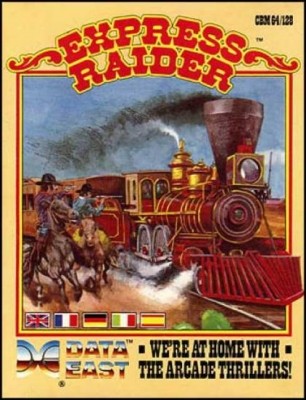
I’ve seen quite a few beatem-up games, though to be honest with you, pretty much all of them involve ninjas and the like, or street fighters, however in this one you happen to be a cowboy, and you are running along the top of the train beating up anybody who gets in your way. Furthermore, you also happen to have just robbed a bank, so it seems that you are trying to get away with as much money as possible (or simply just trying to get away because, well, I suspect the law of the West plays its role here and all that).

Okay, it is probably more than a beatem-up game because when I got to the second level it was more like a shooting gallery where you shoot people who are hiding in the train, while you are riding alongside on your horse. Mind you, I didn’t quite expect that horses would run as fast as trains, but then again this does happen to be a computer game, so I probably should give it a bit of leeway in that regards.

Look, it was okay, but like a lot of the games that I have been playing around with, I found that this one ended up getting particularly hard once I hit the second level – namely the shooting gallery and all that. The first level was pretty easy though, but I guess it had a lot more to do with trying to control your character, and also getting the shots to go where they are supposed to go. In the end though, while it was a nice game, it really isn’t worth spending all your time playing it, despite it being one of those games that the video game magazines back in the day would really hype about them.

Anyway, there doesn’t seem to actually be a Wikipedia page for the game, which sort of suggests that it really wasn’t all that groundbreaking, at least to be remembered. However, you can find an entry on Lemon64, which sort of does say something.

Categories
2 out of 5 C64 Shoot-em Up

Avenger

Publisher: Commodore

Designer: Commodore

Type: Shoot-em Up

Platform: C64

Release Date: 1982

Rating:

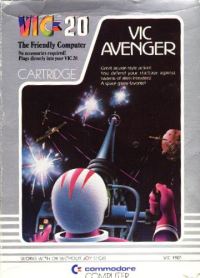
For some reason, the file that this game happened to be in was called Avenger (which as it turns out, is the correct name). Okay, considering that this does happen to be an old C64 game, I wasn’t expecting it to have anything to do with those Marvel characters, or collecting pieces of the infinity stone to defeat Thanos. Rather, I wasn’t actually sure what this game was actually about. So, when I fired it up, you can probably imagine my surprise when I discovered that it was space invaders.

Look, I shouldn’t be too harsh on the game because it is actually one of the original arcade games, and I have played it a few times. I won’t necessarily say that it is easy though, especially since as you go up levels it does tend to get harder and harder. Then again, the more that you shoot, the faster they become. Apparently this started as a bug in the game, but because it worked so well, the original designers decided not to fix it.

However, I have to admit that the game is, well, boring. Like, yeah, its space invaders, and there is only so much of this game that I can play before I want to go and do something else, or even play something else. Still, it is certainly something to remember for posterities sake (and no doubt this isn’t the last time I’ll be writing a review of this game, though it will probably be on a different platform).

So, I guess the reason for the name change is that Commodore (who released the game) didn’t actually have the rights for the original title, so they ended up making their own. Anyway, there is a brief article about this game on Wikipedia, for what it’s worth.

Design a site like this with WordPress.com
Get started