Categories
3 out of 5 C64 RPG

Ultima 3

Publisher: Origin Systems

Designer: Richard Garriott

Type: Roleplaying

Platform: Various

Release Date: 1983

Rating:

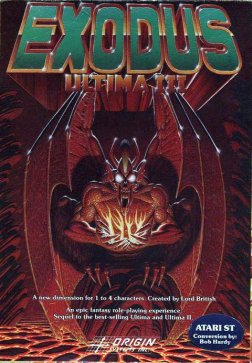
Once again, the Ultima series takes a slightly different turn. Well, first of all, the game has moved away from a single character to where you now have to create a party of characters so be able to solve the game. Also, combat moves into a specific combat screen where you fight against your opponents, which makes it somewhat better than the previous games where you would run around the world trying to escape all of the nasties. Also, one really interesting thing is that you can choose one of three genders, that being male, female, or other (though the choice doesn’t do much). Oh, and there happens to be this race called a Fuzzy, but I have no idea what it is supposed to be.

So, it looks like you haven’t quite finished your job yet because even though Mondain and Minax have both been killed, it seems as if they have left their computer, Exodus, running. Okay, this isn’t quite like the computer that you happen to be using to read this review, but other it is some sort of supercomputer with some hugely impressive AI component that is controlling a world full of nasty monsters. Anyway, your job is to turn it off, and if you think that it just involves pulling the plug, well, it is a little more difficult than that.

I did eventually manage to complete this game, but I can’t say that it was one of my favourites. I guess it is sort of that type of game that straddles the earlier releases, which are sort of a breakthrough, and the really outstanding games that are to come. Though, another interesting thing is seeing what they took, and what they happened to have left behind when they moved onto the next project. For instance, it seems as if creating a party yourself was eventually dropped in the next iteration.

Still, this was a fun game, even if it didn’t quite reach the accolades of some of the others. It was difficult, but not too difficult, but then again that seemed to be the case with a lot of these roleplaying games, where the early part is really hard, but once your characters reach a certain point, then things start to get a little easier. Still, it was fun when I played it, especially with the fact that the whole purpose of the game is to turn off a computer.

Anyway, you can find details about this game on Wikipedia (which shouldn’t surprise anybody), but there are also entries on this game on the Ultima fandom page, as well as on the c64 wiki page. Oh, and if you want a walkthrough, there is one on the Ultima codex.
Categories
3 out of 5 Adventure Interactive Fiction

Voodoo Castle

Publisher: Adventure International

Designer: Scott Adams, Alexis Adams

Type: Adventure

Platform: Various

Release Date: 1979

Rating:

This is a rather interesting turn when it comes to the Scott Adams adventures (a term that seemed to have stuck to these series of games, since he happened to be the developer). Anyway, once again, the plot of this game is a little different to the original one, which was simply running around collecting treasure. However, I guess that is something that sort of hails back to the original adventure game, Colossal Cave (which has since been revamped several times).

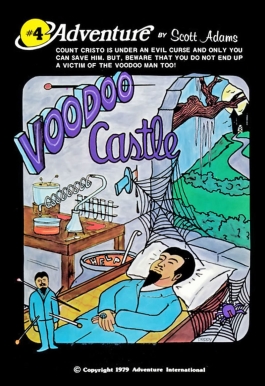
So, the story is that there happens to be this guy, Count Cristo, that has fallen asleep, and it is your job to wake him up. Well, you have an entire castle to explore, and you need to collect the ingrediants for the ritual which is required to perform the task. Well, I have to admit that this is certainly somewhat different.

Like a lot of his games, this one is pretty tricky, but it isn’t so hard as to make it basically uncompletable (I managed to do it as a kid, but I also suspect that I managed to get some help from somewhere, I’m just not sure where). Yet, in a way, as we progress through these games, they do get more and more difficult as time goes one. However, they are still fun, especially when you come back to them after a while and attempt to make your way through them again.

Still, I probably wouldn’t consider this to be one of my favourites, probably because I really am not a big fan of the gothic horror genre, which this game clearly falls into.

Anyway, there is a short entry on Wikipedia for this game, and some details on the Interactive Fiction Database. Also, if you are looking for hints (or even a solution), there are plenty to be found.

Categories
3 out of 5 Run & Shoot SNES

Megaman X

Publisher: Capcom

Designer: Tokuro Fujiwara

Type: Run & Shoot

Platform: SNES

Release Date: 1993

Rating:

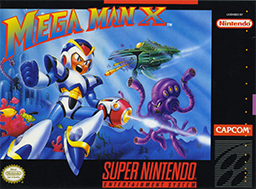
This appears to be the third game in a series, though I’m not entirely sure what went on before. All I know, from the particularly long intro, is that there are these, well, robot types things that have been taken under the care of this character known as Doctor Dopler. Apparently, they were causing problems for Earth, but that had been sorted out (as I said, I don’t know anything about the original games, though I suspect I could easily find out, if I could be bothered searching the internet).

Anyway, it turns out that Doctor Dopler isn’t as good as people think that he was, and these creatures all turn loose and begin raising havoc across the world. You happen to be this guy named Megaman, and you like some sort of future police officer, or more precisely, some future commando of some sort. Well, because you happen to be so good, you get recruited to solve this problem. Except, the headquarters gets attacked and you have to deal with it.

Basically, this game is sort of a cross between a platform game, and a shootem-up, but I’ll put it into the shootem-up category since you seem to do more shooting than jumping about. It took me a while to work out the controls, particularly when you get to the big boss at the end of the first level. However, it turned out that by holding the buttons down you, well, can jump higher, and a fire a much deadlier shot than if you just press them normally. Oh, you also have another ability which allows you to run really, really, fast, though I’m not sure where that is used. Once you complete the first level (which is relatively easy, but it took me a couple of goes), you then have a choice of where to head next.

This game wasn’t bad, and the first level is interesting because you swap between characters a couple of times. Actually, I was a bit surprised to find the character I started playing gets captured halfway through, and you end up swapping characters to rescue him. The other thing is that when you die (you have an energy counter), you don’t go right back to the beginning, but rather back to a save point. Oh, and there is also a password that you can enter which will jump you much further ahead in the game. However, it isn’t one that I’m all that likely to be pursuing much in the future.

Anyway, as you can probably expect, there is a Wikipedia article on this game (as well as the series). Oh, and since it is a series, there a Megaman wiki, and an entry on the character as well. If you are looking for a solution, there is also one on Strategywiki.

Categories
3 out of 5 Maze Miscellaneous Arcade SNES

Pacman

Publisher: Namco

Designer: Namco

Type: Maze

Platform: SNES

Release Date: 1980

Rating:

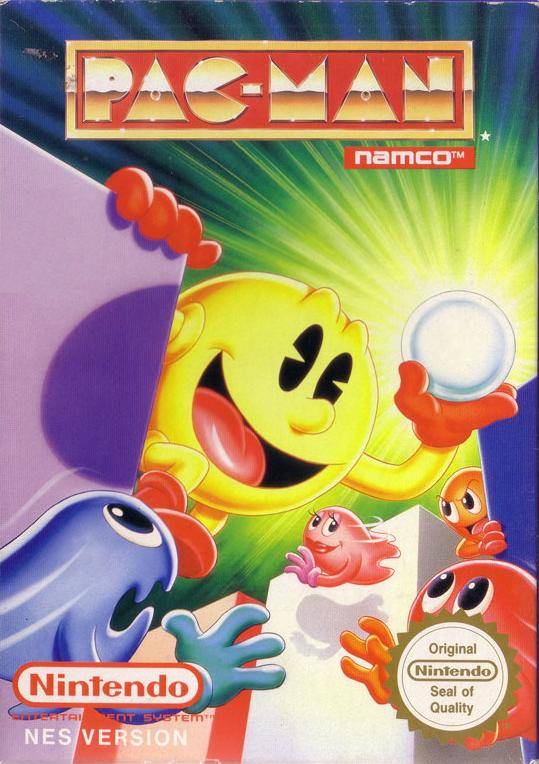
After a rather disastrous experience with the Atari version of Pacman, I decided to see what the SNES version was like, and whether it was any easier. Well, my judgement is that it is, though there is still the problem that Pacman can be pretty difficult to control. I guess the reason for that is because once you start him moving, he just doesn’t stop. However, with this version, I did manage to complete the first level, so I guess I can say that it is certainly better.

This game does look a lot more like the version that you would see in the arcade parlours though, and it certainly runs much better as well. The graphics do match the original game, and of course, the ghosts each have their own personality. One thing I noticed is that they don’t all pile out of their inner sanctum at once, which can make it a little tricky. It is also tricky when you find yourself snookered.

Another thing that I noticed is that the maze changes slightly as you progress up the levels. Once again, I’m not sure if that is what is supposed to happen in the original, but it certainly gives this version of the game some more flare to it. However, as I mentioned, it does happen to be difficult, especially since Pacman isn’t as controllable as one would like him to be. Yet, I guess that just adds to the thrill of the game.

Categories
3 out of 5 C64 RPG

Pool of Radiance

Publisher: Strategic Simulations Inc.

Designer: Chuck Kroegel

Type: Roleplaying

Platform: Various

Release Date: 1988

Rating:

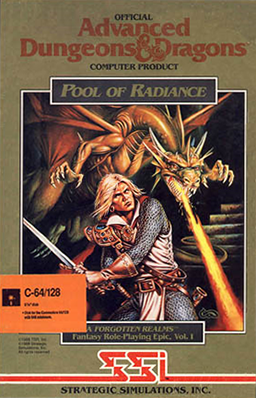
I believe that this was basically the first of the official Dungeons and Dragons games, and it certainly showed it. Mind you, I do remember when it was first released, and it was all the rage, namely because my friends and I loved Dungeons and Dragons, so when an official game was released, we all wanted a copy of it so we could not only play it but see who the first to complete it world be (spoiler – it wasn’t me).

So, the whole idea is that you create a party and then you have to go into this ruined city and clear it out of all of the monsters therein. The first level, for want of a better word, was the slums, and I remember that the final battle in the slums was really, really hard, namely because you were low-level characters and had to fight a bunch of ogres are trolls – gee, that was fun.

The interesting thing was that the next level you had to go and fight undead. Seriously, what is it with fighting undead on the second stage of the game – all of the games seemed to do that for some reason. In fact, I find undead overused, and rather boring

Pools of Radiance was a good game, and rather challenging, though of course being the first of a series certainly showed a lot. Obviously, they were still trying to tweak the game as the next ones were produced. I did manage to complete it, and it certainly did get easier one you managed to get through that really annoying battle with the trolls and the ogres (honestly, who thought that a bunch of first level characters could actually beat them). The game was also open to being mapped as well, though back in those days maps tended to be placed on pieces of papers, which meant that I had a huge graph book full of maps form the various games that I played.

Sure, this isn’t going to stand up to any of the modern games, and in hindsight, it really wasn’t all that great either, compared to the forerunners that really set the scene up. However, it was still fun, and does deserve its place in history.

Anyway, you can find out more about this game on Wikipedia, and of course it has an entry on the Forgotten Realms Fandom wiki. Oh, and you might also be looking for a walkthrough as well, and yes, there is one.

Categories
3 out of 5 RPG

Ultima I: The First Age of Darkness

Publisher: Origin Systems

Designer: Richard Garriot

Type: Roleplaying

Platform: Various

Release Date: 1981

Rating:

As you can probably discern from the title, this was the very first of the Ultimas, a game that ended up not only spawning eight sequels, several offshoots, and one of the first MMORPGs. So, this one takes up right back to the beginning where we can experience what it was like to actually play a computer roleplaying game back in the early eighties, and it certainly does have quite a lot of charm about it, even if it might not be on the scale of Skyrim.

Well, considering that it was originally released on an 8-bit machine, we certainly can’t expect Skyrim, but then again, for its time, it certainly did break a lot of boundaries. In fact, you had a quest, which differs from a lot of the other games at the time, which just involved you descending into dungeons and killing as many monsters as possible until you died. No, this one you had to go on a quest to kill a powerful mage.

The game involved you travelling over multiple continents, visiting multiple towns, and descending into multiple dungeons, mostly to build up your power so that you could then go and deal with that really nasty mage that you are supposed to kill. It was fun when I played it, and it certainly did steal hours of my life back when I was a teenager.

I guess, as I mentioned, it is certainly not something that you could hold up to modern games, but it is great to see what it was like back in the day. Oh, and the game was initially a top-down view, but that changed when you entered the dungeons. This was a format that the game used for most of its sequels, at least until Ultima 6 (as far as I’m aware).

Anyway, not surprisingly, this game appears on Wikipedia (something a a number of other games haven’t managed to do, which probably says a lot about that particular game). Also, I have discovered two wikias from Ultima – the Codex of Editable Wisdom, and the Ultima Codex. Of course, there are plenty of walkthroughs as well, of which this is one.

Categories
3 out of 5 Arcade Adventure Nes

The Legend of Zelda

Publisher: Nintendo

Designer: Takashi Tezuka

Type: Arcade Adventure

Platform: NES

Release Date: 1986

Rating:

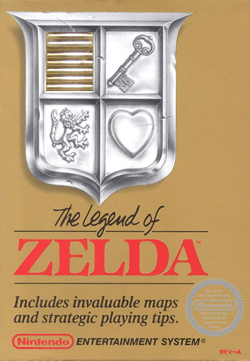
I’m not quite sure whether I could go as far as suggesting that this game is a proper roleplaying game, though I should point out that you do have quests, and you can not only pick up things, but you can also increase your character’s power through collecting, and buying, items. The other thing about this game is that fortunately when you die (you really don’t have that much in the way of health) is that while you go back to the start, you retain all of the stuff that you had when you were killed, which certainly does make this game a little easier.

Still, in many ways, this game does feel like it is just another arcade-style game, but I shouldn’t be too harsh on it because we are dealing with one of the original Nintendo consoles, which means that you only had two buttons on your controller. Also, the nasties that you have to battle aren’t all that fancy, but once again, I should point out that we are dealing with a rather old retro-game here.

It is fun though, despite it being pretty basic, and it certainly does look as if it is a pretty big game, which means that it is going to give you hours upon hours of gameplay. However, the instructions do point out that the nasties do get harder the further into the game you get, which sort of worried me because I found that the nasties around the start were pretty bad nonetheless. Yet, despite that, I did find out once you play it for a while you do eventually get the hang of the engine, which does make dealing with them somewhat easier.

Yeah, this game isn’t too bad, and of course, when we look at the later consoles that came about, there is certainly something to look forward too.

Anyway, you can find more information of this game (as well as the series as a whole) on Wikipedia, though I should mention that this game has a whole wikipage to itself as well, which you can also enjoy.

Categories
3 out of 5 C64 RPG

Sword of Fargoal

Publisher: Epyx

Designer: Jeff McCord

Type: RPG – Rogue Like

Platform: C64

Rating: undefined

This is what is termed as a ‘rogue-like’ game, namely it is a rather simply constructed roleplaying game that involves you exploring a dungeon, killing monsters, and collecting treasure. This is one of those games that I played quite often back in the day, namely because it was quite simple, which compared to a lot of other rogue-like games, is certainly saying something. You basically start off on the first level of the dungeon, and make your way down as far as you can go before you happen to be killed off by one of the many monsters (or traps) that happen to populate the labyrinth.

It was fun, and as I mentioned, rather simple. The fact that you could play the game with a joystick (or controller) made it quite playable, and if you were lucky, you could certainly go quite far. Mind you, you only had a limited amount of space for gold, but you could also deposit gold into one of the temples, which happened to be on each of the levels, and it would be converted into experience. There were also magical items, such as potions and spells, that you could use, though there weren’t too many which meant that the keyboard interaction was limited.

The thing I don’t like about the game is that when you advance a level your hit points basically stay the same, and healing does take quite a while, unless of course you manage to find either a regeneration spell, or a healing potion. The other thing is that the game ends up being pretty repetitive, which meant that after a while I would end up losing interest in it.

One thing that I do remember though is that the game was written in BASIC, and my brother managed to not only discover that, but also hack into it so that the number of special squares that appeared per level increased by something like four. Mind you, these days, if I were to be able to break into the code, it might be possible to rewrite the code to make it even more beneficial, though once again, that sort of defeats the whole purpose.

If you are interesting in finding out more about this game, there is always Wikipedia, though you can also go to the C64-Wiki, or even Lemon 64. If worse comes to worse, well, you could simply type ‘Sword of Fargoal’ into your favourite search engine.

Design a site like this with WordPress.com
Get started