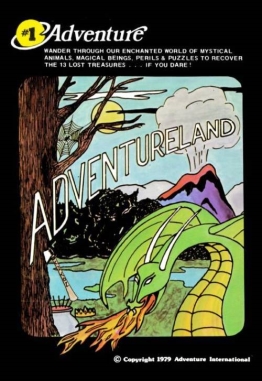
Publisher: Creative Computing Software
Designer: Scott Adams
Type: Adventure/Interactive Fiction
Platform: C64
Release Date: 1978
Rating: 
While this isn’t the first-ever adventure game (or should I call it an ‘Interactive Fiction’ which is what they seem to be called today) it certainly is up there with the originals. I should point out first of all that this is entirely text-based, though later iterations of this game did have graphics added to it, that doesn’t mean that you can simply sit down with your controller and play it as if you were playing Super Mario Bros.
No, this is a game where you enter commands into the parser, effectively telling the computer what you want to do. The parser is two words, namely action and verb, though sometimes it might as for some clarifications. A description of the room is given to you at the top of the screen, as well as any items that you might see there, which does give you a bit of a hint as to what can be done there.
It’s not really that hard, but then again I did complete it when I was something like nine years old, and it has been around for so long that you can easily find a solution of the internet. However, that doesn’t mean that you should actually use the solution because it sort of destroys the fun of trying to work out what to do, and to solve all the puzzles.
The concept is pretty simple though, you have to find all of the treasures, bring them back to one particular spot, and then type on Score. Once you have all the treasures there, then you basically win the game. Mind you, I generally bring each and every item back to this one spot as well, namely because it helps me know where things are. However, you don’t really need to do that as the treasures are pretty obvious when you come across them.
Well, I decided that I would replay it (after initially writing this review) namely because it is a rather short game, and I hadn’t played it for a while. One of the things that I noticed is that if you die, you go to limbo, where you can escape if you head in the right direction. Mind you, there are a few ways of dying, such as wandering into the meadow with some evil-smelling mud, which results in the dragon waking up and killing you. However, despite the fact that you can sort of escape death, that doesn’t mean you can’t get snookered, as there are things that you can do that will make the game impossible to complete.
Oh, and for the problems, well, they are generally okay, but there are a couple, such as the one involving Paul Bunyan, that sort of end up having you guess how to deal with it. Okay, knowing the story probably won’t help all that much, but while most of the problems can be solved (or have hints as to solving them), some of them require a bit of joining a couple of rather distant dots together. Also, considering problems, there is a graphical version on the C64 (the version I played), and you can tell that it is the first because you need to switch between the pictures, and the text, which is quite annoying mind you.
As I said, it isn’t really that easy, but the problems are solvable. The catch with this game is that you don’t necessarily know all of the commands that you can use, and this it sometimes takes some guesswork. However, for the first in a series, it still is pretty good, and it certainly does have a lot of historical value as well.
Anyway, you can find out more about this game on Wikipedia, and of course, if you want to play it, along with the many emulators and versions that exist, you can also play it online.

 Games & Tech with the Sarkologist